
How to Check Criminal History in Philadelphia County
No single search returns every Philadelphia County criminal record. Start by deciding what the record must answer. The Unified Judicial System portal is best for a filed prosecution and its outcome. The Philadelphia Department of Prisons locator answers whether someone is now in local custody. A Philadelphia Police records check is limited to local arrest information. PATCH is the Pennsylvania State Police product for disseminable statewide history. Each source captures a different point in the same process.
Names alone can produce weak matches. Gather the full legal name, known aliases, date of birth, approximate event date, and any docket, incident, or police identification number. Then follow the record from its source to its outcome. Use this order for a broad self-review:
- Search UJS Docket Sheets under Philadelphia Municipal Court and the Court of Common Pleas.
- Open each likely docket and compare the filing date, arresting agency, charges, and identifiers.
- Check current local custody through the Philadelphia Department of Prisons locator or its phone fallback.
- Request the local police report or police records check from the Department of Records when the police layer matters.
- Use PATCH, or mail PSP Access and Review for a subject’s fuller Pennsylvania self-audit.
Philadelphia County Record Channels
Philadelphia County records are divided by custodian. The Sheriff’s Office secures courts, moves prisoners, serves writs, and supports fugitive work, but it does not run the jails or serve as the general police-report counter. The Philadelphia Police Department and Department of Records handle police-created material. The Department of Prisons controls local custody data. The Office of Judicial Records keeps criminal court files.
| Question | Official channel | What it adds |
|---|---|---|
| Was a case filed? | UJS Docket Sheets and OJR Criminal | Charges, events, disposition, sentence, and costs |
| Is the person in local custody? | Philadelphia Department of Prisons | Current facility and custody information |
| What did police report? | Department of Records or PPD | Incident, arrest, crash, or eligible audio and video material |
| What does Pennsylvania disseminate? | PSP PATCH | State repository name-check result |
| Is there state custody or parole? | PA DOC Inmate/Parolee Locator | State prisoner or parolee status |
This division prevents a common error: asking one office for a record held elsewhere. It also explains why a recent police contact may not appear on a court docket, and why a docket may show a case after local custody has ended.
Official Pennsylvania Background Checks
The Pennsylvania State Police Criminal Records and Identification Division maintains the Central Repository. Its public product is Pennsylvania Access To Criminal History, or PATCH. An ordinary online or mail request costs $22. Notarization adds $5. A volunteer product is free and cannot be notarized. PATCH covers Pennsylvania law-enforcement history in the repository, not federal records.
The official PATCH entry screen shows where a requester starts a new check and later validates its status.
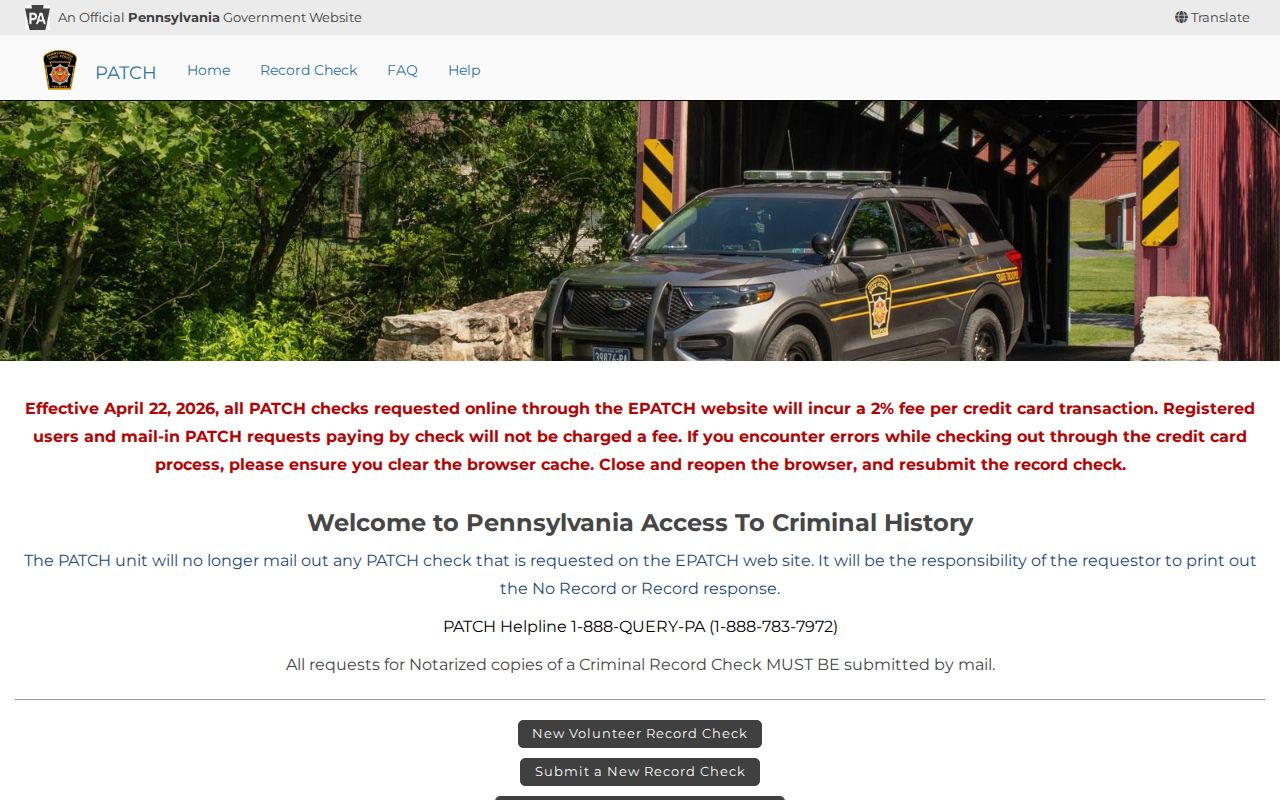
The screen is a state repository channel, not a substitute for reading the Philadelphia County court case or police file that produced an entry.
| Official product | Fee | Scope and channel |
|---|---|---|
| PATCH individual | $22 | Pennsylvania public repository product, online or mail |
| PATCH notarized | $27 total | Same check with notarization under product rules |
| PSP Access and Review | $20 | Subject-only Pennsylvania record, including non-convictions, by mail |
| FBI Identity History Summary | $18 plus capture costs | Subject-only fingerprint-linked federal history |
| IdentoGO purpose check | Varies | Statutorily authorized fingerprint check using the supplied service code |
PATCH and Philadelphia County Checks
PATCH reports one of three broad results: No Record, Request Under Review, or Record. Under Review does not prove that a record exists. It means PSP must examine a possible match. A nonregistered request may remain under review for up to two weeks or longer. Save the control number, subject name as entered, and request date because the validation screen uses those values.
The PSP PATCH overview explains the status terms shown in the state process.
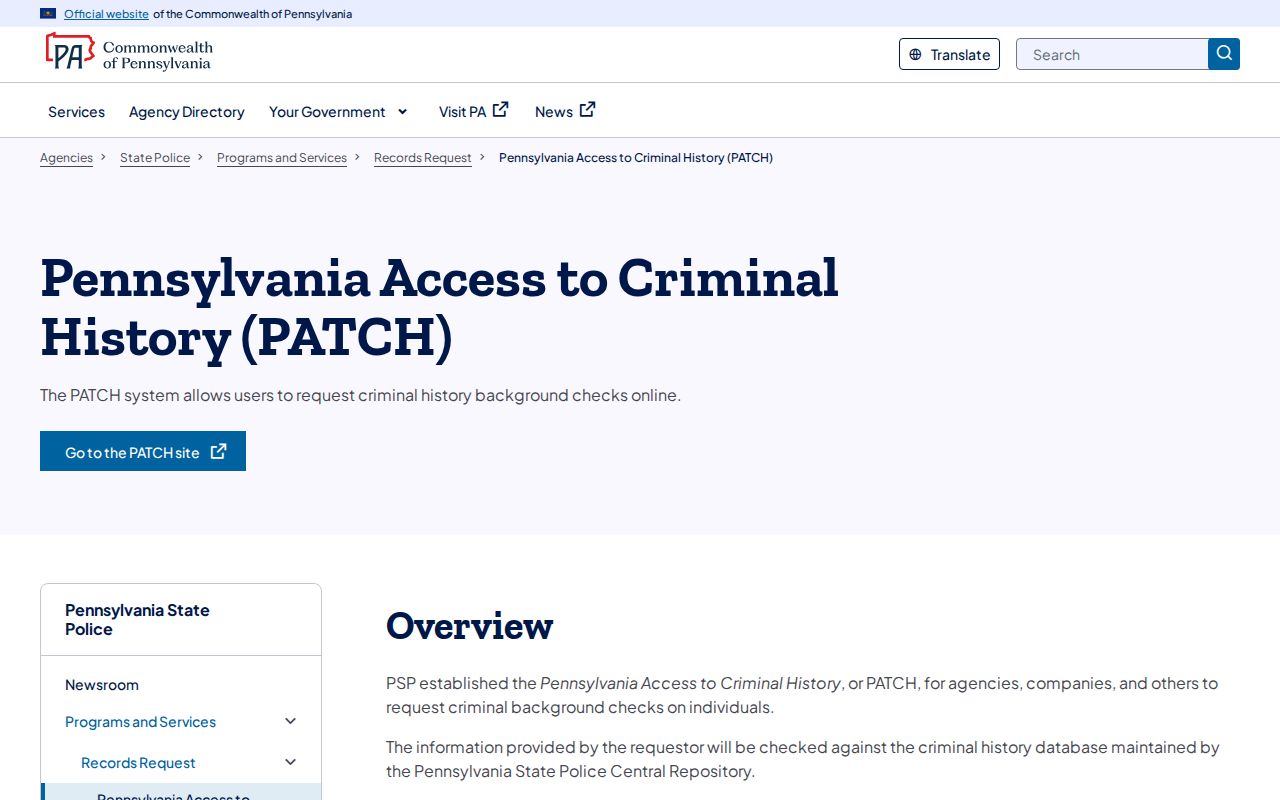
A printed PATCH certificate should be compared with the Philadelphia County docket when a charge, disposition, or identity link looks wrong. For a complete self-review, the broader mail-only Access and Review product is the better correction starting point.
Types of Criminal Records
Philadelphia County criminal records are snapshots, not duplicates. Police create incident and arrest reports. The Police Detention Unit and Department of Prisons create booking and custody records. Prosecutors file complaints and informations. Municipal Court and Common Pleas preserve dockets. PSP connects reportable arrests and dispositions in the state repository. Other systems cover warrants, supervision, prisons, and registry duties.
- Incident and arrest report: alleged conduct, event identifiers, officers, location, and initial offenses.
- Booking and custody record: intake identity, commitment, bail, facility, and release status.
- Court case file: filed charges, motions, hearings, disposition, sentence, and financial obligations.
- Repository history: fingerprint or identifier-linked arrest cycles and reported outcomes held by PSP.
- Restricted record: juvenile, sealed, limited-access, investigative, or other protected material withheld from ordinary view.
A record’s name matters. A booking entry proves custody, not guilt. A docket proves that a prosecution was filed, not that every police allegation was accepted. A registry profile is a statutory public-safety publication, not a full criminal history.
Philadelphia County Custody Records
Local confinement belongs to the Philadelphia Department of Prisons, not the Sheriff. Its four active sites sit on State Road: Curran-Fromhold Correctional Facility, the Detention Center, the Philadelphia Industrial Correctional Center, and Riverside Correctional Facility. The sites have distinct functions. Riverside is the main women’s facility, while the Detention Center now serves a major medical role.
The City publishes a locator and a daily census. The census is aggregate transparency, not a list of arrests. For a name search, use the local locator and call Prison Information at (215) 685-8394 when spelling, transfer, or processing delay may hide a match. State prisoners and parolees appear in the PA DOC locator; federal custody belongs in the BOP locator. Moving through all three layers is often necessary after a transfer.
OJR Criminal
Stout Center for Criminal Justice
1301 Filbert St., Philadelphia, PA 19107
(215) 683-7703
Public Safety Records
City Hall, Room 170
1400 JFK Blvd., Philadelphia, PA 19107
(215) 686-2266
PPD Open Records
400 N. Broad St., 4W-72
Philadelphia, PA 19130
(215) 686-3277
What a Philadelphia County Criminal Record Shows
The fields depend on the record. A Pennsylvania rap sheet emphasizes identity and arrest cycles. A UJS docket emphasizes court events, decisions, and money due. A Philadelphia County booking entry focuses on intake and present custody. Compare identifiers before treating records with the same name as one person.
| Name & Identifiers | Primary name, aliases, birth details, state identification, FBI number, and transaction identifiers when present |
|---|---|
| Arrest / Booking Data | Arrest date, contributing agency, incident or control number, commitment, bail, facility, and release |
| Charges & Statutes | Charge sequence, offense text, statutory citation, grade, and later amendments |
| Disposition | Dismissal, withdrawal, nolle prosequi, plea, verdict, acquittal, or conviction by count |
| Sentence | Confinement, credit, probation, restitution, fines, costs, and concurrent or consecutive terms |
| Custody / Supervision | Facility or release data, probation entries, detainers, violations, and state parole status where public |
Victim details, Social Security numbers, protected addresses, medical data, investigative material, sealed counts, and juvenile information may be removed. A public docket is also an index. It may name an order or filing without displaying the underlying document.
Philadelphia County Report Requests
Police incident and offense reports are requested by mail or in person through the Department of Records. Current City guidance estimates 10 to 12 weeks. Crash and fire reports have an online application. A local police records check and letter of good conduct use their own form and are estimated at 10 days. The local check warns that it covers Philadelphia arrests only.
At the public-safety counter, payment may be made by cash, money order, business check, or certified check payable to the City of Philadelphia. Personal checks and cards are not accepted in that workflow. Include the report or DC number when known, event date and time, exact location, involved names needed to locate the file, requester relationship, identification, and the requested delivery method.
The Philadelphia open-records policy separates ordinary Right-to-Know Law requests from police audio and video requests.
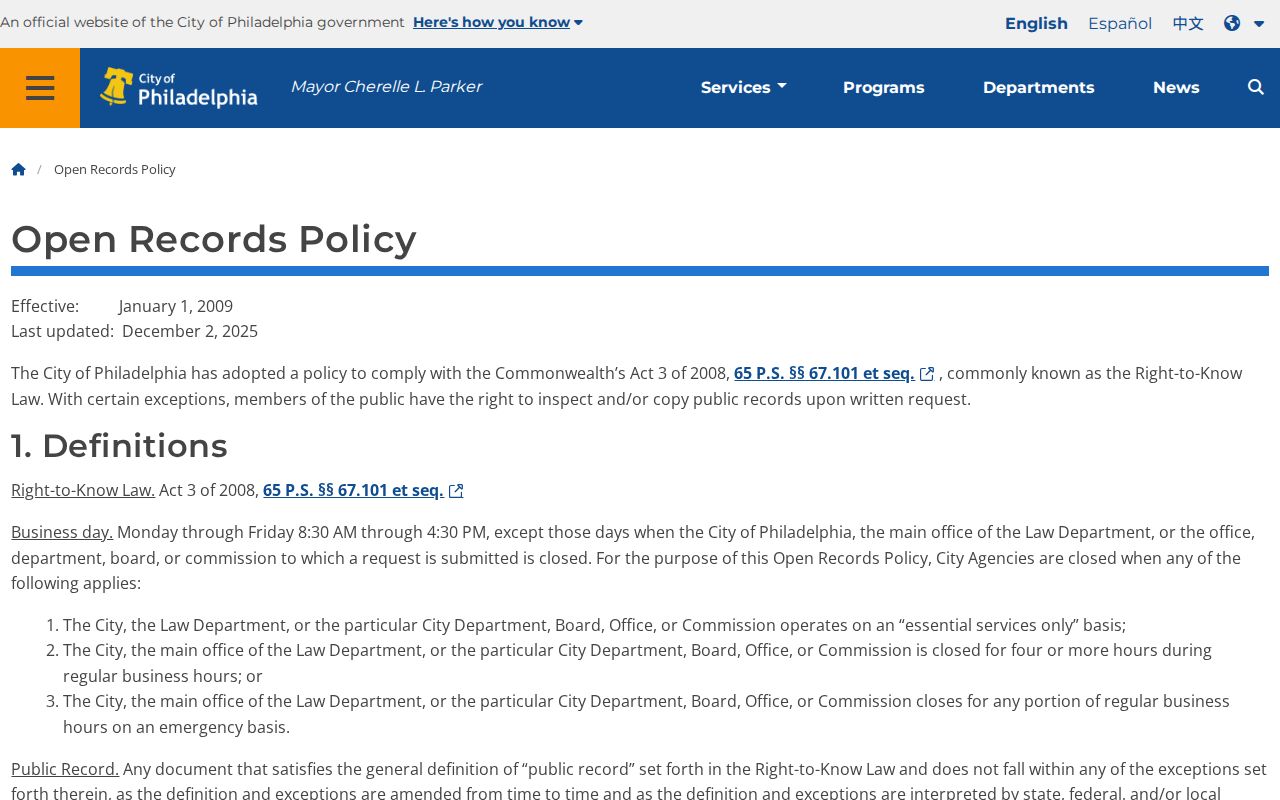
Body-camera and other law-enforcement audio or video requests follow Act 22 and go to PPD’s Open Records/Right-to-Know Section, in person or by certified mail.
Public Access Laws
Pennsylvania law does not make every criminal record public. The Right-to-Know Law opens many agency records but preserves exemptions. Judicial records follow the UJS public-access policy and their court custodian. PSP dissemination has separate rules. Act 22 controls requests for law-enforcement audio and video. The correct channel depends on who holds the record and what kind of material it contains.
Key statutes and policies:
Pennsylvania Right-to-Know Law permits public access to agency records while preserving listed exemptions.
18 Pa.C.S. § 9121 governs criminal-history dissemination and limits disclosure of protected charges.
UJS public-record policies set access, request, custodian, and protected-information rules for court files.
18 Pa.C.S. Chapter 91 covers expungement, limited access, Clean Slate, and juvenile-record relief.
A City response within five business days is an initial response, not a promise of production. An agency may grant access, deny it, or invoke a lawful extension. Investigative information, victim and minor data, secure identifiers, and sealed records can be withheld or redacted.
Philadelphia County Warrant Records
No complete official public Philadelphia warrant-name portal was verified. A bench-warrant event may appear in UJS Docket Sheets. OJR can confirm public docket information, while the Sheriff and PPD fugitive functions handle execution. Search warrants and sealed investigative warrants may stay unavailable before execution.
When resolving one’s own possible warrant, first identify the court and docket. Contact counsel or the court’s official unit for safe surrender or hearing instructions. Later, confirm that the docket shows recall or lifting. Payment alone does not always remove a criminal bench warrant. Never rely on an unofficial database or an unsolicited caller to decide that a warrant is valid.
- Bench warrant
- A court order often issued after a failure to appear or violation of a court order.
- Arrest warrant
- A warrant based on a complaint and a judicial finding of probable cause.
- Docket
- The court’s chronological record of filings, hearings, orders, and case status.
- Disposition
- The recorded outcome for a charge or case, such as dismissal, plea, acquittal, or conviction.
Sealed, Expunged & Restricted
Expungement and limited access are not the same remedy. Expungement removes qualifying criminal-history information as authorized by Pennsylvania law. Petition-based limited access seals eligible convictions from ordinary public dissemination. Clean Slate limited access applies automatically to defined records when statutory rules are met. Courts and criminal-justice agencies can retain authorized access to limited-access records.
For a Philadelphia County self-audit, identify each docket in UJS and obtain PSP Access and Review. File the correct petition in the court that handled the case, with accurate charge and outcome data. Required notice may go to the District Attorney. After an order, check both the public docket and a later PSP record. If the entry remains, provide the certified order and identifiers to the reporting office and PSP Expungement Unit.
Dismissed does not mean deleted. An acquittal or withdrawal changes the court outcome, yet an arrest trace may still need relief under Pennsylvania law. Juvenile records use separate rules under 18 Pa.C.S. § 9123.
Philadelphia County Supervision Records
The First Judicial District’s Adult Probation and Parole Department supervises Philadelphia court cases. The Pennsylvania Parole Board makes state release decisions, while PA DOC supervises state parolees. Public information is fragmented. A UJS docket can show the sentence and violation events. The PA DOC locator may show state parole status. Detailed officer notes, treatment information, risk assessments, addresses, and supervision conditions are not a general public database.
A docket line marked probation proves the sentence, not current compliance. Violations can be technical or tied to a new allegation, and may lead to a detainer, hearing, treatment response, modified conditions, or revocation. Philadelphia’s reform work includes early-termination and absconder reviews, which helps explain why a later supervision status may not be obvious from the original sentencing entry.
Philadelphia County Federal Records
Federal cases form a separate layer. Philadelphia County lies in the U.S. District Court for the Eastern District of Pennsylvania. PACER carries federal dockets and filed documents after registration. Federal custody is searched through the Bureau of Prisons locator. Neither source replaces the City’s custody locator, the state prison locator, or Pennsylvania court dockets.
The Eastern District of Pennsylvania identifies the federal courthouse and its services.
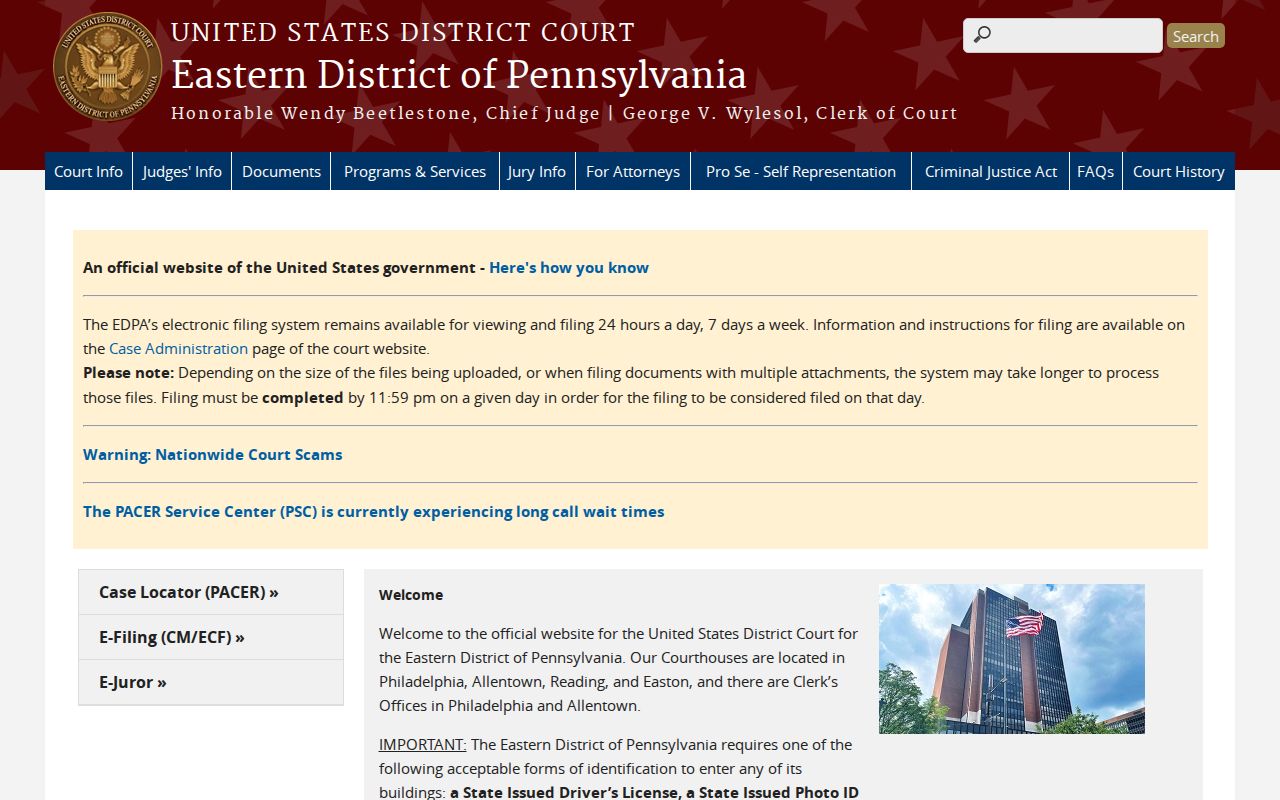
The federal courthouse does not issue an FBI Identity History Summary. That subject-only product starts through the FBI application channel and requires fingerprints.
Philadelphia County Justice Reforms
Philadelphia’s Safety and Justice Challenge changed local custody and case-processing work. Named efforts included bail advocates in the Police Detention Unit, prompt detention review, long-stayer review, police-assisted diversion, probation early-termination work, and 911 triage. These programs affect how long people remain in custody and how cases move, but they do not change which office holds the official record.
The Defender Association of Philadelphia describes defense services that connect with bail, probation, and record-clearing work.

Those services help people address their own cases, while certified records still come from the court or originating agency. An official City milestone reported a 3,480-person jail population on May 15, 2025, the lowest in more than 33 years. The Philadelphia jail-population announcement displays the trend behind that count.
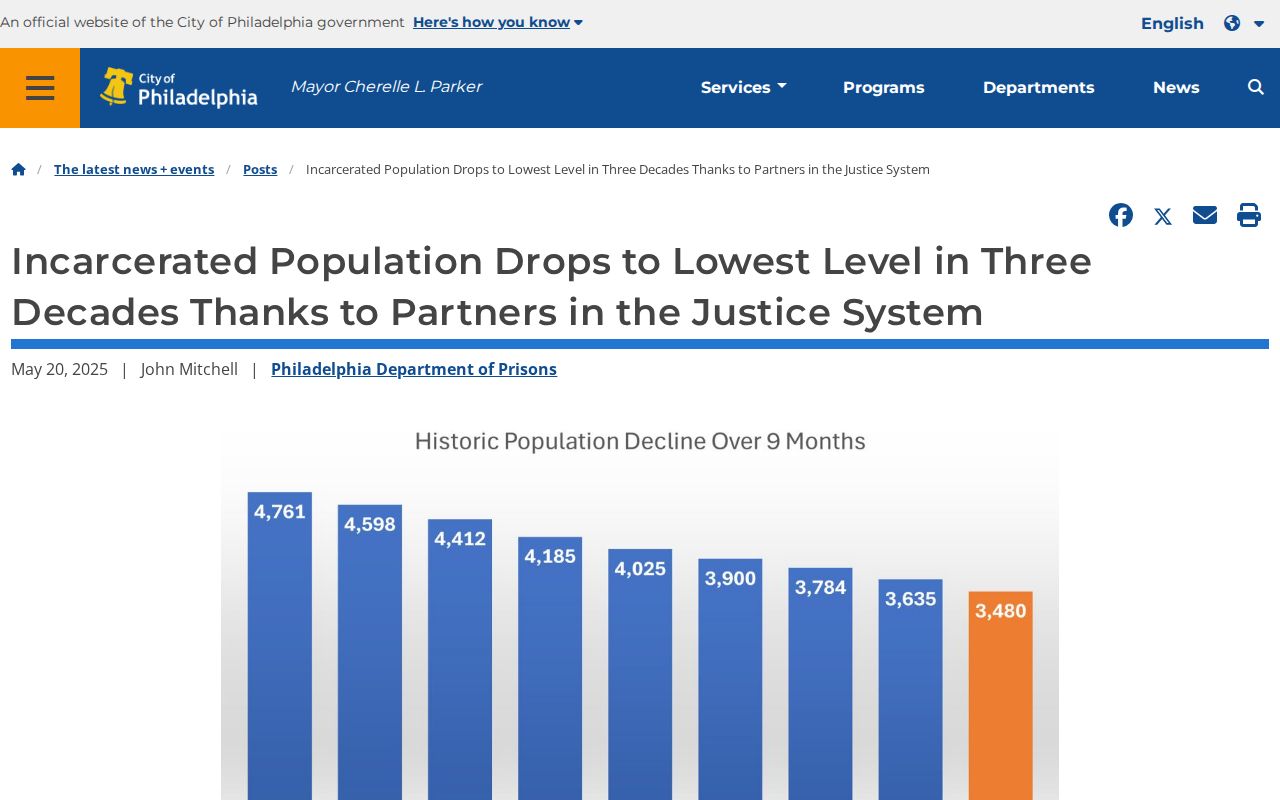
The decline is custody and system-workload context. It should not be treated as a direct crime-rate measure.
Criminal Records by City in Philadelphia County
Philadelphia County is coterminous with the City of Philadelphia and has no other incorporated cities. Neighborhoods such as Germantown and Manayunk are not separate cities with independent police departments or courts. City-level record work therefore begins with Philadelphia Police, the Department of Records, Philadelphia Municipal Court, and the Department of Prisons.
Philadelphia Criminal History
2024 estimate: 1,573,916 · PPD reports and Municipal Court dockets
The Philadelphia city record page stays at local altitude, including police districts, City Hall report requests, Municipal Court, and the State Road booking path.