
Criminal Cases in the Philadelphia County Courts
The First Judicial District joins Philadelphia Municipal Court and the Court of Common Pleas in one local court system. Municipal Court conducts preliminary proceedings in felony matters and decides many lower-level criminal cases. If a felony is held for court, the prosecution moves to the Common Pleas Criminal Trial Division. Philadelphia County does not use the magisterial district courts found elsewhere in Pennsylvania.
The Office of Judicial Records, or OJR, is the custodian for Philadelphia County criminal case records. Its criminal operation serves both court levels. A police report explains an alleged event, while an OJR case file records what prosecutors filed and what judges did. Readers who need arrest and booking context can separately consult the Philadelphia County arrest history channels.
Philadelphia County Felony Dockets
One Philadelphia County felony prosecution may produce a Municipal Court docket and a later Common Pleas docket. That is not proof of two separate cases. The first docket can show the complaint, preliminary arraignment, bail, and preliminary hearing. The later docket can show the formal information, motions, plea or trial, disposition, and sentence.
Compare the participant, incident or complaint identifiers, filing dates, and charge history before joining the records. Search each court type on its own. A charge may be withdrawn at the lower stage, amended, or carried forward under a new sequence in Common Pleas. Reading each charge line prevents an early allegation from being mistaken for the final count.
How to Search Case Records
The free UJS Docket Sheets search is the main online path for public Philadelphia County criminal court records. No account is required to view public docket sheets. UJS warns that a docket search is not a criminal-history check. It answers what happened in a court case, not what the Pennsylvania State Police may disseminate in a repository record.
- Open Case Search and select Philadelphia Municipal Court or Court of Common Pleas.
- Choose the criminal category, then search by exact docket number or participant name.
- Use Philadelphia County, date of birth when known, filing dates, and case status to narrow common names.
- Open the docket and check the charge, event, bail, disposition, sentence, and financial sections.
- Repeat the search in the other court for a felony, then ask OJR for any needed filing or certified copy.
| Field Label | Type | Required | Notes |
|---|---|---|---|
| Search Type | Tabs or radio | Yes | Use participant name or docket number. |
| Court Type | Dropdown | Yes | Select Municipal Court or Common Pleas separately. |
| Case Category | Dropdown | Varies | Choose Criminal for the selected court. |
| County | Dropdown | Narrowing | Select Philadelphia. |
| Docket Number and Type | Segmented text | For docket search | Enter the exact year, sequence, and type. |
| Participant Name | Text | For name search | Last name is primary; first name narrows results. |
| Date of Birth | Date | No | Use when known to reduce false matches. |
| Filed Date and Status | Date and dropdown | No | Limit by filing period or active/disposed status. |
The official UJS interface shows the controls used for this search.
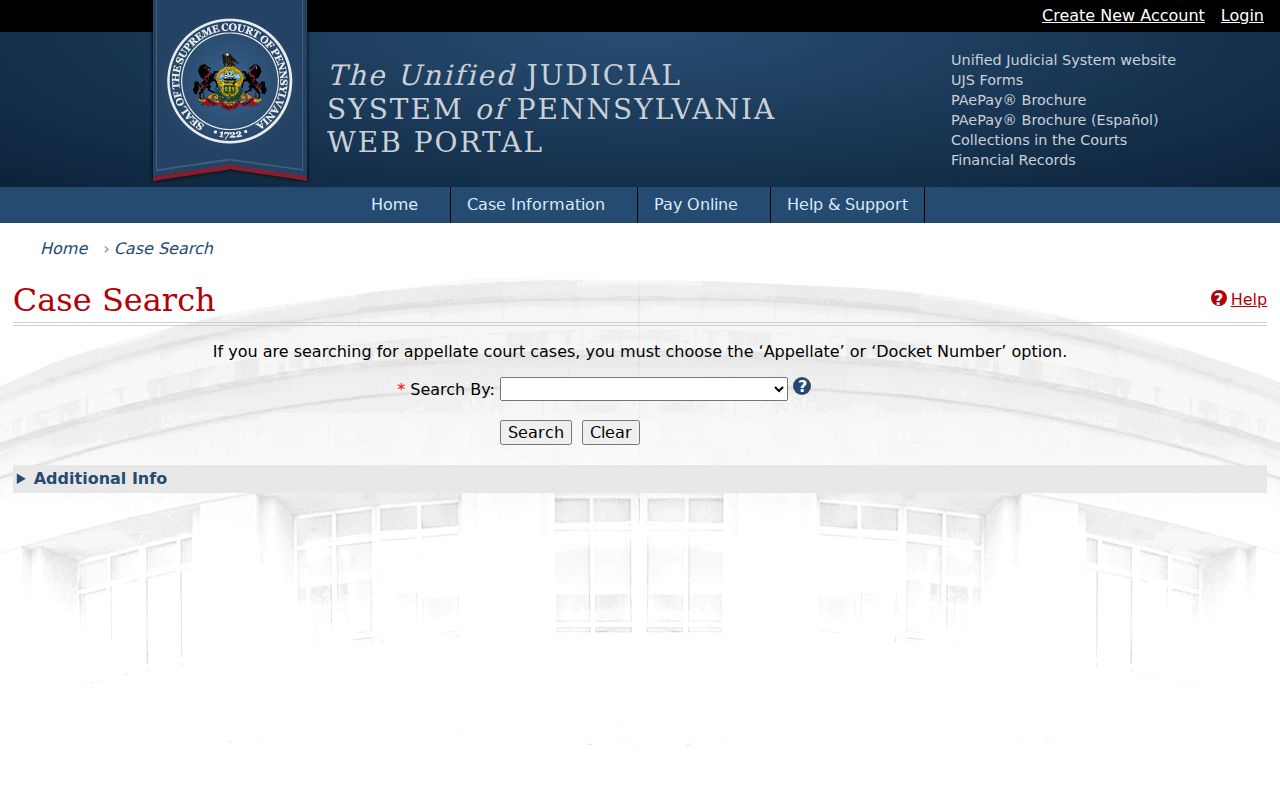
The screen helps a searcher choose the right court before relying on a result.
Philadelphia County Court Records Counter
The Justice Juanita Kidd Stout Center for Criminal Justice is at 1301 Filbert Street, Philadelphia, PA 19107. It houses Municipal Court criminal work, Common Pleas Criminal Trial Division activity, and public-facing OJR functions. Older instructions may call it the Criminal Justice Center or CJC. Those names point to the same Filbert Street courthouse.
OJR Criminal handles case-record questions at (215) 683-7703 and OJRCriminal@courts.phila.gov. Counter locations can change, so confirm the room before a trip. Entry involves security screening. The First Judicial District’s official landing page is the source for current court notices.
The district page is the best checkpoint for current Philadelphia County court operations before calling or visiting.
OJR Criminal
Justice Juanita Kidd Stout Center
1301 Filbert Street
Philadelphia, PA 19107
(215) 683-7703
What the Case File Shows
A Philadelphia County criminal case file is a court record, not a full police file. The public docket summarizes the prosecution. It can identify the court, filing date, judge, participant, arresting agency, charges, attorneys, hearings, outcome, sentence, and money due. Pleadings and orders may require a separate copy request.
| Case Number and Court | Identifies the docket, court level, county, filing date, caption, judge, and status. |
|---|---|
| Charging Record | Lists each offense, statute, grade, count, and filed or amended charge sequence. |
| Docket Entries | Dates and descriptions for filings, orders, hearings, and other recorded events. |
| Bail | Shows type, amount, posting status, changes, and revocation apart from guilt. |
| Disposition | Records the outcome and date for each charge, including dismissal, plea, verdict, or withdrawal. |
| Sentence and Finances | May show confinement, probation, credit, restitution, costs, fines, and payment balance. |
Victim details, protected addresses, sealed counts, and sensitive identifiers are omitted or redacted. A docket also may point to a document without displaying its full text.
Philadelphia County Case Dispositions
Read Philadelphia County disposition data charge by charge. “Disposed” means the court recorded outcomes. It does not always mean the person has paid every balance or finished supervision. A Philadelphia County dismissal ends that charge without a conviction, but it does not by itself erase every arrest or repository trace. An acquittal is a not-guilty result, while nolle prosequi records the prosecutor’s formal choice not to proceed, subject to court rules.
- Information
- The prosecutor’s formal charging document for a Common Pleas trial.
- Disposition
- The recorded result of a case or individual charge.
- Nolle prosequi
- A formal decision by the prosecutor not to proceed on a charge.
- Concurrent
- Sentences ordered to run at the same time.
- Consecutive
- Sentences ordered to run one after another.
Charge grade also matters. Pennsylvania law sets different maximum terms by grade, but the grade is not a forecast of the actual sentence. Use the grade shown on the docket rather than guessing from the offense title.
Stages of a Criminal Case
A Philadelphia County case begins when the prosecution files charges in court. Municipal Court handles the early felony path and many lower-level matters. A felony held for court then advances to Common Pleas, where pretrial motions and a plea or trial lead to the final outcome. Scheduled events are not proof that an event occurred, so confirm the later docket entry.
Case flow: Charges Filed › Arraignment › Pretrial › Plea or Trial › Disposition › Sentencing
Bail is a separate track within that flow. Its type, amount, posting status, or revocation does not decide guilt. Sentence entries can combine confinement, probation, restitution, and terms that run at the same time or in sequence.
Note: A Municipal Court docket can end while the linked Common Pleas case remains active.
Request Philadelphia County Case Files
When UJS gives only an index or no public document, use the First Judicial District Request for Case Records. Identify Common Pleas or Municipal Court, the Criminal division, case caption, docket number, record sought, and a date range. State whether inspection, a plain copy, or certification is needed. The docket number is the strongest locator.
Older or archived Philadelphia County criminal court records may require staff retrieval. Copy or certification fees can apply under the current OJR schedule. Judicial case records follow the court public-access policy, not the City’s ordinary Right-to-Know Law process. An incomplete request can slow the search, so name the exact order, filing, or docket sheet when possible.
Philadelphia County Docket Limits
UJS itself distinguishes a public docket from a Pennsylvania State Police criminal-history product. The court record follows one prosecution and may omit the underlying incident report, evidence, witness material, or sealed component. PATCH instead reports what the PSP Central Repository may disseminate under Pennsylvania law. Neither should be substituted for the other.
The Pennsylvania courts’ official case-information explanation states that public docket data is not a background check.
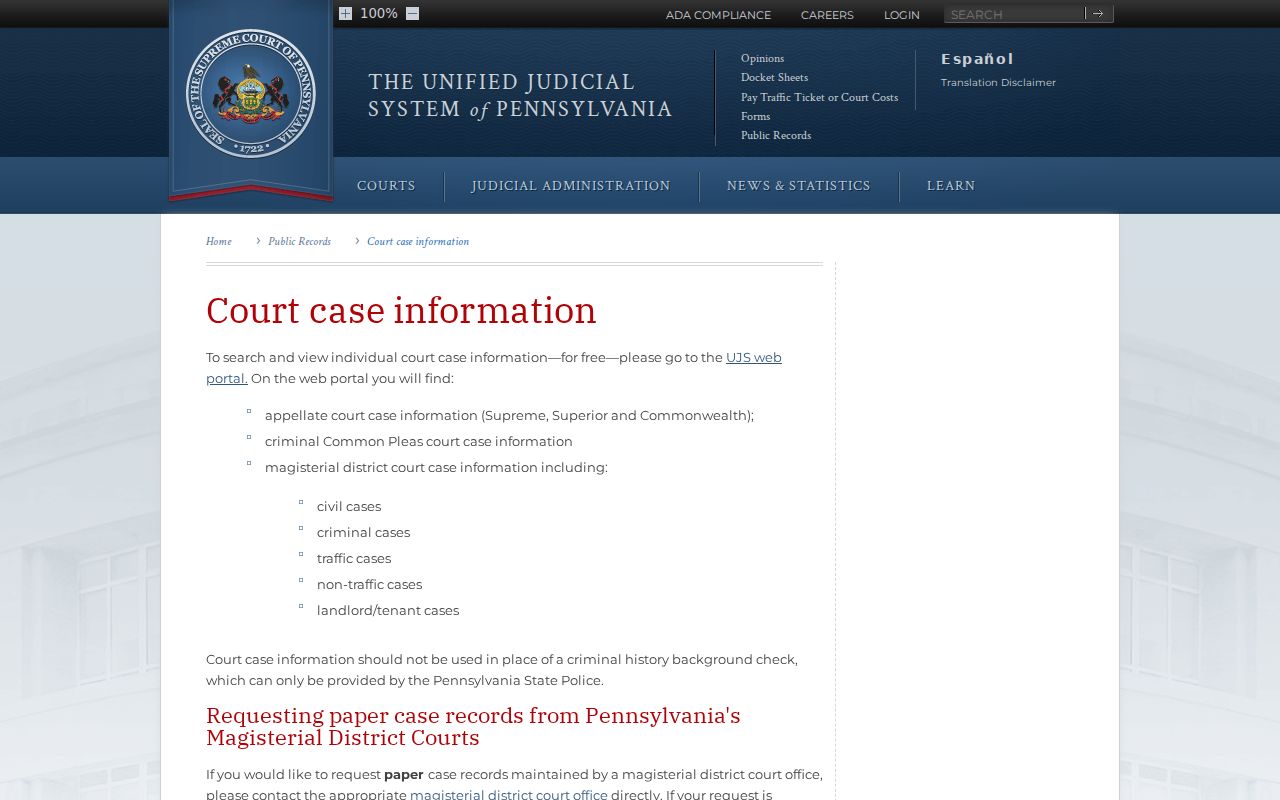
That boundary explains why a self-audit may need a court docket, a local police record, and a PSP Access and Review.
Access & Restrictions
Pennsylvania’s UJS Case Records Public Access Policy controls Philadelphia County judicial case records and the proper custodian. Public access does not expose every field. Protected personal identifiers, victim and minor information, sealed counts, and secure documents may be withheld or redacted. Philadelphia County juvenile files follow distinct confidentiality rules.
The Pennsylvania Right-to-Know Law applies to many agency records, but it is not the default route for an OJR criminal case file. Police audio and video use the separate Act 22 process. Limited-access and Clean Slate orders can remove qualifying information from ordinary public view without destroying all authorized justice-system access.
Missing Philadelphia County Case Records
A missing result can reflect a spelling variant, the wrong court level, a filing lag, a protected record, or an archived file. Search both Philadelphia court types and try the exact docket number first. Use dates and birth information only when known. Do not infer that no case exists from one blank name search.
If the case should be public, contact OJR Criminal and submit the case-record form. If a disposition is wrong, compare the signed court order with the docket and ask the custodian how to correct the entry. Repository errors are handled through PSP Access and Review and the contributing court or agency, not by editing UJS.